Queer Places:
University of Oxford, Oxford, Oxfordshire OX1 3PA
St. Mary the Virgin Churchyard, Townsend Rd, Aldworth, Reading RG8 9SB, United Kingdom
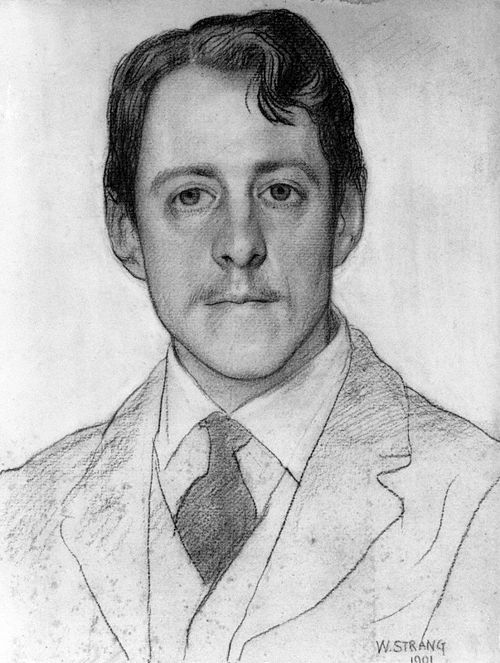 Robert Laurence Binyon (August 10, 1869 – March 10, 1943) was born on August 10, 1869, in Lancaster, England, the son of a Church of England clergyman,
Frederick Binyon, and Mary Dockray, with family roots extending back to the Quakers. Educated at St Paul's School in London and Trinity College, Oxford,
he distinguished himself early academically by winning the prestigious Newdigate Prize for poetry in 1891.
Robert Laurence Binyon (August 10, 1869 – March 10, 1943) was born on August 10, 1869, in Lancaster, England, the son of a Church of England clergyman,
Frederick Binyon, and Mary Dockray, with family roots extending back to the Quakers. Educated at St Paul's School in London and Trinity College, Oxford,
he distinguished himself early academically by winning the prestigious Newdigate Prize for poetry in 1891.
During his university years and early literary development, Binyon became integrated into fin-de-siècle artistic and literary networks. Through
connections initiated by Lionel Johnson, he was introduced to
Herbert Horne, who subsequently connected him with
Arthur Mackmurdo, the architect and founder of the Century Guild, and the artist
Selwyn Image. These cultural circles placed him in close proximity to various aesthetic movements of the late
nineteenth century.
Immediately following his graduation in 1893, Binyon embarked on a long and distinguished career at the British Museum, starting in the Department of
Printed Books before moving to the Department of Prints and Drawings. Over the decades, his institutional role expanded significantly. By 1909 he was
Assistant Keeper, and in 1913 he became Keeper of the newly established Sub-Department of Oriental Prints and Drawings. In this capacity, he heavily
influenced early Modernism in London by introducing young Imagist poets, including Ezra Pound,
Richard Aldington, and H.D., to East Asian visual art and literature.
In 1904, Binyon married the historian Cicely Margaret Powell, and the couple had three daughters: Helen, Margaret, and Nicolete, all of whom grew up to
pursue artistic or scholarly careers. Before the outbreak of the First World War, Binyon was a prominent figure in British letters, to the extent that
upon the death of Poet Laureate Alfred Austin in 1913, his name was widely discussed in the press as a potential successor.
Deeply moved by the heavy casualties sustained by the British Expeditionary Force at the onset of the First World War, Binyon wrote his most enduring
work, "For the Fallen," in 1914. Published in The Times, its central verses—specifically the "Ode of Remembrance"—became a permanent fixture of
Remembrance Sunday services across the UK, Australia, New Zealand, Canada, and South Africa. Demonstrating a practical commitment to the war effort, he
volunteered in 1915 and 1916 as a hospital orderly in France, tending to wounded soldiers from the Battle of Verdun, experiences he documented in prose
and verse.
Following the war, Binyon resumed his scholarly pursuits at the British Museum, producing foundational texts on William Blake, Persian art, and
Japanese and Chinese print culture, before retiring in 1933. His later academic career featured prestigious appointments, including serving as the Norton
Professor of Poetry at Harvard University from 1933 to 1934 and as the Byron Professor of English Literature at the University of Athens from 1940 until
he was forced to flee the German invasion in April 1941. Throughout his later years, he dedicated extensive effort to translating Dante's Divine Comedy
into terza rima, a monumental project aided editorially by Ezra Pound and published between 1933 and 1943.
Binyon continued writing poetry through the Second World War, producing "The Burning of the Leaves," a reflection on the London Blitz widely regarded
as his poetic masterpiece. He passed away following an operation on March 10, 1943, at the Dunedin Nursing Home in Reading, at the age of 73. His ashes
were scattered at St Mary's Church in Aldworth, Berkshire, and in November 1985, he was commemorated alongside sixteen other Great War poets on a slate
stone unveiled in the Poets' Corner of Westminster Abbey.
References:
- Oxford Dictionary of National Biography (ODNB): Features the definitive biographical entry on Laurence Binyon, written by his primary biographer, John Hatcher.
- Laurence Binyon: Poet, Scholar of East and West by John Hatcher (Oxford: Clarendon Press, 1995) – The first full-length critical biography examining his dual legacy in British poetry and Asian art scholarship.
- The British Museum Archives: Holds extensive institutional records regarding his four-decade career, his administrative tenure as Keeper of Prints and Drawings, and his foundational museum catalogues.
- Dictionary of Art Historians: Documents his professional trajectory, museum curatorship, and contributions to the study of Eastern art and Western print culture.
- Encyclopædia Britannica (11th Edition): Includes early historical entries detailing his status and career trajectory prior to the First World War.
- First Book of London Visions (1894)
- The Winnowing Fan (1914) – containing "For the Fallen"
- For Dauntless France (1918) – chronicling his hospital orderly service during World War I
- Collected Poems (Two Volumes, 1931)
- The Burning of the Leaves and Other Poems (1944)
- The Madness of Merlin (1947)
- Dutch Etchers of the Seventeenth Century (1895)
- Painting in the Far East (1908)
- The Flight of the Dragon: An Essay on the Theory and Practice of Art in China and Japan (1911)
- The Spirit of Man in Asian Art (Harvard University Press, 1935)
- Dante's Divine Comedy (Translated into English terza rima across Inferno, Purgatorio, and Paradiso, published between 1933 and 1943)
Support this project
This website is a passion project researched, developed, and funded entirely by me. If you find the content valuable and would like to help support the ongoing research and hosting costs, any contribution is deeply appreciated.
Thank you for keeping this independent resource alive!
My books on Amazon: Elisa Rolle's books
BACK TO HOME PAGE